Artificial Intelligence & ML
Open-weights model evaluation, agents, alignment, interpretability, applied ML for the sciences.
Eight innovation tracks. Three age divisions. One global pool. Free to enter from anywhere in the world. Travel, accommodation and visa support fully covered for every finalist.
Solo or in teams of up to four. Junior (13–15), Senior (16–18) or Collegiate (19–24) division. No school sponsorship required.
Entry is free for every student, in every country. No tier upgrades, no franchise fees, no qualifying-round purchases. Ever.
Cash prizes, lab residencies, continuation grants, mentorship, university recommendation letters, and a published paper in the XTF Proceedings.
Each track is led by a panel of working researchers and engineers in that field. The track brief below summarises the open questions XTF reviewers are most eager to see addressed in 2026 — but the brief is a starting point, not a fence. The best XTF projects often define a problem we hadn't thought of.
Open-weights model evaluation, agents, alignment, interpretability, applied ML for the sciences.
Carbon removal, clean energy, climate-resilient materials, food & water systems, adaptation.
Synthetic biology, low-cost diagnostics, neuroscience, longevity research, global health.
Autonomy, mechatronics, precision sensing, distributed manufacturing, agritech robotics.
Quantum information, novel architectures, photonics, post-quantum cryptography, simulators.
CubeSats, propulsion, planetary science, remote sensing, suborbital experiments.
Cryptography, privacy-preserving computation, digital rights, secure-by-design systems.
Civic tech, accessibility, learning technology, humanitarian engineering, open data.
Click a track for the full brief, scoring rubric and recommended reading list. (All briefs are linked from Guidelines.)
2026 questions of interest: (a) small-model evaluations on under-served languages; (b) mechanistic interpretability of agents on tasks with verifiable ground truth; (c) applied ML for materials, climate or biology where the science is the contribution. Reviewers explicitly do not reward "scale of model used" — they reward clarity of question and rigour of method.
Direct air capture, soil carbon, low-cost monitoring, climate-resilient materials, adaptation in coastal and arid regions. Bonus weighting for projects that include life-cycle analysis and that use publicly available datasets (Copernicus, NASA, NOAA, ERA5).
Low-cost diagnostics, paper microfluidics, open-hardware lab tools, synthetic biology with non-pathogenic chassis, neuroscience studies using public datasets, longevity biomarkers. All wet-lab work must include a documented safety review by an adult supervisor with the appropriate credentials.
Open-source hardware encouraged. Bonus for designs that publish CAD, BOM and firmware under permissive licenses. Strong interest in agritech robotics (especially for smallholder farms), warehouse and lab automation, and assistive/accessibility devices.
Conceptual, simulator-based, or hardware projects all welcome. Cloud-quantum credits are available via XTF's Compute Grant. Reviewers are especially curious about projects that explain a hard idea unusually well — quality of exposition counts.
CubeSat design and mission proposals, propulsion concepts, suborbital payloads, satellite imagery analysis for environmental or humanitarian questions. Hardware projects must include a clear "ground-tested vs. flight-ready" delineation.
XTF will not accept any project that demonstrates offensive use against real, non-consenting systems. We welcome: cryptographic research, privacy-preserving ML, threat modelling of consumer devices (with vendor coordination), and tools that protect at-risk users.
Civic tech, accessibility tooling, educational software, humanitarian engineering. Strong preference for projects deployed (even at small scale) with real users, and for designs co-developed with the communities they serve.
| Division | Ages (on 31 Dec 2026) | Typical schooling | Team size |
|---|---|---|---|
| Junior | 13–15 | Lower secondary / middle school | 1–4 |
| Senior | 16–18 | Upper secondary / high school | 1–4 |
| Collegiate | 19–24 | Undergraduate (any year) | 1–4 |
Team registration goes live on xtf.org/register. Free, indefinite while registration is open. Choose your track and division.
Registered teams may request mentor matching. Matches are made on a rolling basis through July.
First round of "Builder" and "Compute" grant applications closes. Decisions: 15 May.
Second and final round of "Builder" and "Compute" grants. Decisions: 31 July.
Final research paper, video and supporting materials due. No exceptions for late submissions.
Every submission is read by at least three independent reviewers, scored against the published rubric.
Top 5% per track move to semi-finals. All entrants receive written, signed reviewer feedback.
Shortlisted teams present live to track panels. The top three projects per track per division advance to the Grand Finals.
Two days of demos, posters and live judging. XTF covers travel, visas and accommodation for every finalist (and one supervising adult per under-18 team).
Grand Champion announced at the close of day two. Certificates issued the same evening — see the certificate format below.
Finalists eligible to apply for Continuation Grants. XTF Mentor relationships continue for up to 24 months.
Cash prizes are paid to the team, not the school. Teams choose how to split. For under-18 teams, prizes are held in a custodial XTF education account until the participant is 18 or until the family designates a guardian account. Award amounts for each tier are confirmed annually and published to each team's dashboard once shortlisting is complete.
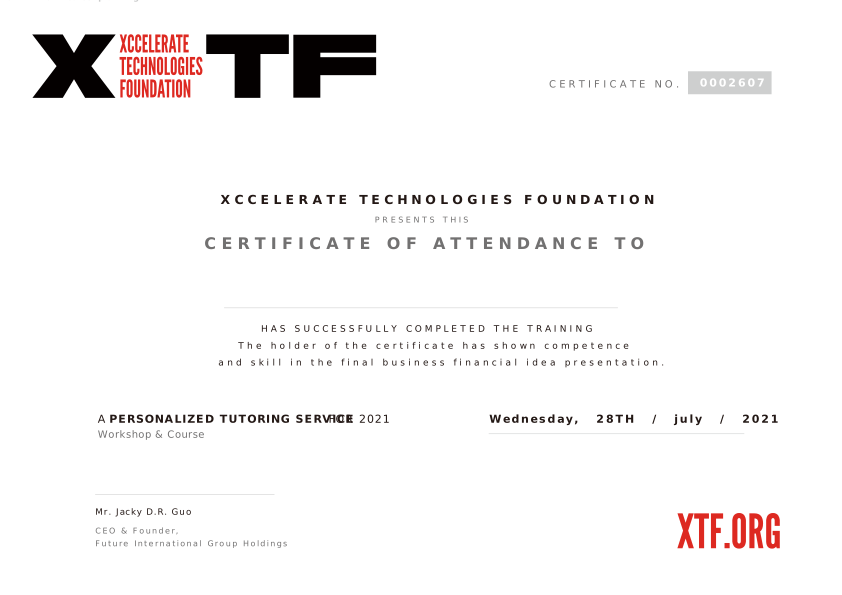
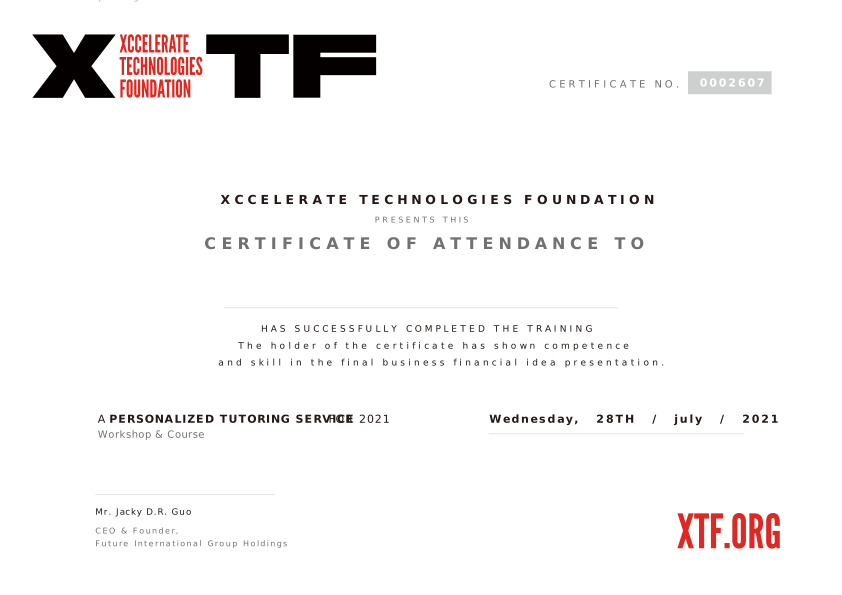
XTF Certificates are signed by the Executive Director and the relevant track panel chair. Each certificate carries a unique seven-digit number and a public verification record at xtf.org/verify. Certificates are issued in print (mailed worldwide free of charge) and as cryptographically-signed digital PDFs.
Universities and employers can verify any XTF certificate by entering its number on our public registry — no login required.
Is the question well posed? Is the method appropriate? Is the analysis honest about its limits?
Does the work add something the field didn't already have — a result, a method, a clearer framing?
If this worked at full scale, what would it change? Is the problem worth solving?
Does the prototype, code or experiment actually work? Is it documented well enough for someone to reproduce it?
Can the team explain the work to a curious non-specialist without losing the rigour?
Blind first round (names/countries redacted). Two of three reviewers must agree on advancement. Any judge with a conflict recuses. Full rubric: Guidelines.
It takes about ten minutes. You don't need a school sponsor. You don't need to have finished your project. You don't even need to know which track you'll choose yet.